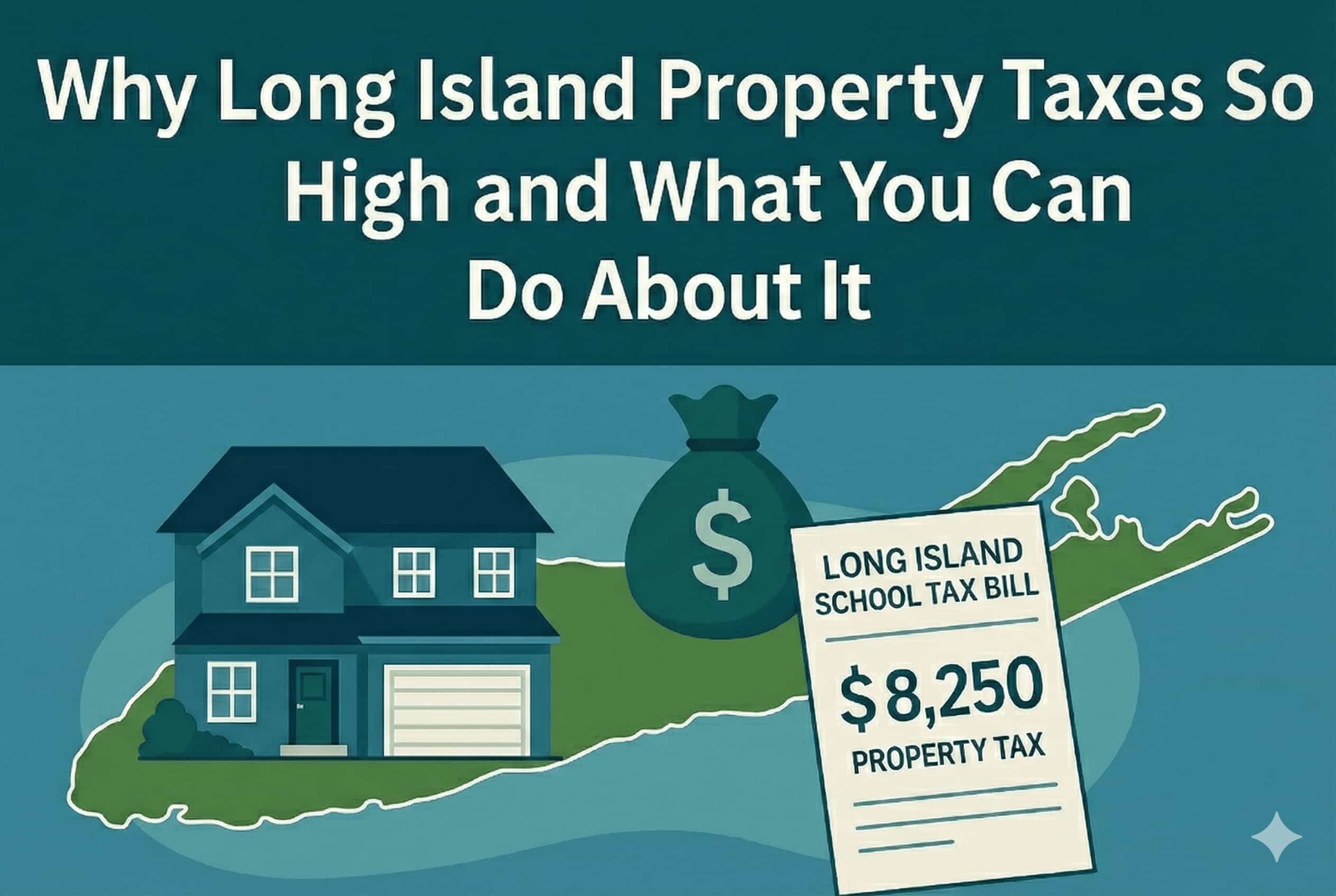
Why Long Island Property Taxes Are So High — and What You Can Do About It
Introduction
If you live on Long Island, you already know the reality: property taxes are some of the highest in the country. But why is that? And more importantly — what can homeowners actually do about it?
In this article, we break down the history behind Long Island’s high taxes, how school funding plays a role, and the options homeowners have to reduce their assessments and save money.
Why Are Long Island Property Taxes So High?
1. School Funding Drives the Majority of Your Tax Bill
Unlike many parts of the U.S., Long Island relies heavily on property taxes to fund public schools. High-performing school districts require larger budgets for:
- Staffing
- Special education services
- Transportation
- Extracurricular programs
- Safety and facility maintenance
This creates a cycle: strong schools push home values higher, and higher values contribute to higher assessments and taxes.
To see what homeowners are currently experiencing during this tax year, explore our recent post: 2025–26 School Tax Season: What Long Island Homeowners Are Experiencing.
2. Local Government & Special Districts
Long Island property tax bills are made up of many layers — it’s not just school taxes.
Your bill may include funding for:
- Fire districts
- Library districts
- Waste management
- Water districts
- Parks and community services
- Police/Public Safety
Each one comes with its own tax rate, which adds up quickly. Even if county taxes stay level, special districts can still push your overall bill higher annually.
3. Nassau County’s Assessment Challenges
One of the top search queries we see is: “Why are Nassau property taxes so high?”
Here’s a key reason:
For decades, Nassau’s assessment system has faced criticism for being outdated, inconsistent, and confusing. While re-assessments and reforms have been introduced, many homeowners still:
- Pay taxes based on inaccurate home valuations
- Are assessed too high compared to neighbors
- See their tax bills rise even when home values drop
This creates opportunities for grievance filings, but most homeowners don’t realize they’re eligible.
4. High Cost of Infrastructure & Services
Long Island counties and towns have higher operating costs than many regions, especially in areas like:
- Road maintenance
- Public safety
- Utilities
- Transportation planning
Those costs are often passed down to property owners through annual tax increases.
Property Tax Reduction on Long Island: What You Can Do
The good news: you are not stuck with your current tax bill.
Long Island homeowners have legal rights to challenge their assessments and potentially reduce their taxes.
1. File a Property Tax Grievance
A grievance is a formal request asking the county to review and potentially lower your home’s assessed value.
Homeowners file grievances because:
- Their assessment is too high
- Comparable homes in their neighborhood are assessed lower
- Their property value has changed
- Their taxes have risen even when the real estate market slowed
Even if your taxes don’t go down, there is no penalty for filing.
2. Know the Deadlines for Nassau & Suffolk Counties
You can only file once per year, and the deadlines are strict.
Missing this window means waiting another full year to try again.
P.T.R.C., Inc. handles all filing deadlines, paperwork, and follow-up automatically — making the process simple and stress-free.
3. Don’t Make Common Filing Errors
Many DIY homeowners forget:
- Comparable property data
- Market research
- Correct documentation
- Accurate home descriptions
These errors can cause their grievance to be rejected.
For guidance, see:
Stop Overpaying on Your Property Taxes — a helpful overview of why filing matters and what homeowners often overlook.
How P.T.R.C., Inc. Helps
Property Tax Reduction Consultants has served tens of thousands of Long Island homeowners for over 30 years.
Our team:
- Reviews your property assessment
- Compares similar local home values
- Files a grievance on your behalf
- Handles hearings and negotiations
And most importantly:
No reduction = no fee.
If we don’t successfully lower your taxes, you don’t pay us.
Final Thoughts
Long Island property taxes are high for many historical and structural reasons — but homeowners are not powerless.
Understanding why taxes are high is the first step. Knowing what to do about it is where P.T.R.C., Inc. comes in.
If you think you're paying too much, let us review your assessment and determine if you qualify for a reduction.
Contact P.T.R.C., Inc.. today for a free assessment and start saving this year.
Return
